
Practical workforce training for accurate claims, responsible oversight, and timely reporting.
Give your healthcare team a shared understanding of how to recognize and respond to fraud, waste, and abuse. Supremus Group LLC’s Healthcare Fraud, Waste & Abuse Prevention Training connects employee responsibilities with the policies, controls, and reporting processes that support responsible healthcare operations.
This online, self-paced course contains 120 slides across 12 modules, with narrated instruction, healthcare examples, fictional decision-making scenarios, response explanations, and module reviews. It addresses Medicare and Medicaid issues alongside risks involving clinical documentation, claims, vendors, referrals, payments, and patient information.
Designed for healthcare employers, compliance leaders, practice administrators, and training managers, the course provides a foundation you can pair with your organization’s local policies and role-specific instruction.
$25 per learner | Online, self-paced | Certificate of Completion
Course Information for Training Managers
| Course Detail | Information |
|---|---|
| Official course name | Healthcare Fraud, Waste & Abuse Prevention Training |
| Provider | Supremus Group LLC |
| Price | $25 per learner |
| Delivery | Online, self-paced learning with audio narration |
| Curriculum | 120 slides organized into 12 modules |
| Practice activities | Healthcare examples, fictional scenarios, and response explanations |
| Assessment | Course knowledge assessment |
| Online access | After 60 days, or once you start the test, whichever comes first, you will no longer have access to the course. |
| License | Individual learner |
| Completion document | Certificate of Completion after meeting course requirements |
| Certificate term | One year under the course’s certificate policy |
The online access period and certificate term serve different purposes. Access determines how long the learner can use the training account for this course. The certificate term follows the course’s policy and does not establish a universal legal renewal schedule for every healthcare role.
Connect Training to the Work Your Teams Perform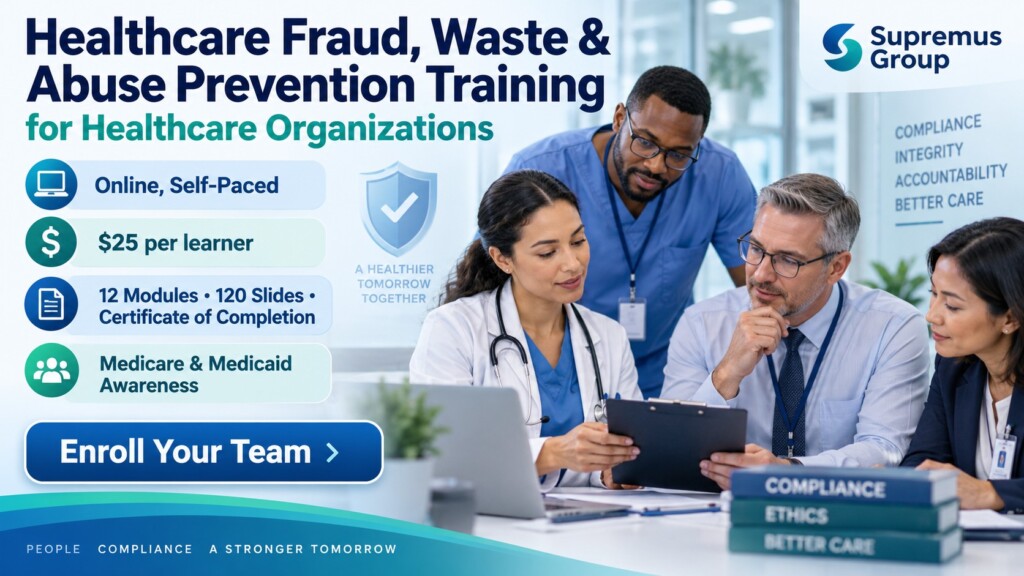
FWA prevention involves more than reviewing claims after payment. Decisions made during registration, patient care, documentation, purchasing, and management review can all affect the accuracy of a record or transaction. The course helps departments understand their part in that process and recognize when a concern needs another specialist.
Clinical Services and Documentation
Physicians, nurses, therapists, pharmacists, and clinical support staff review the connection between actual care and the record used to support payment. Topics include patient-specific medical necessity, copied notes, practitioner involvement, treatment time, and truthful corrections. The emphasis is on documenting what happened rather than adjusting the record to fit a revenue target.
Billing, Coding, and Claims Operations
Billers, coders, claims processors, registration employees, and revenue cycle teams learn to recognize unsupported codes, duplicate submissions, incorrect units, and inconsistent information. The training also addresses payment reconciliation and the importance of referring to possible overpayments for timely review.
Purchasing, Finance, and Vendor Management
Employees responsible for suppliers, invoices, financial relationships, and outsourced services examine conflicts of interest, referral incentives, patient assistance, and payment verification. Examples reinforce the need to review actual services and results rather than rely only on a contract, vendor promise, or automated report.
Compliance, Human Resources, and Leadership
Compliance officers, HR personnel, administrators, supervisors, and organizational leaders can use the course as a common awareness foundation. Lessons connect training with reporting channels, fair standards, risk assessment, auditing, monitoring, and corrective action. Managers also review how incentives and responses to employee concerns can support or undermine written policies.
Examples span hospitals, practices, home health, hospice, nursing facilities, rehabilitation, behavioral health, pharmacies, laboratories, equipment suppliers, health plans, and healthcare transportation. Medical courier examples address delivery records and vendor invoices without treating specimen transport as the same service as ambulance care.
Learning Outcomes for Your Workforce
After completing the training, learners should be able to:
- Recognize concerns without jumping to conclusions. Distinguish fraud, waste, abuse, and honest errors, and explain why an unusual claim or payment needs review rather than an immediate accusation.
- Connect records and payments to actual work. Identify unsupported documentation, coding, service quantities, practitioner information, and financial arrangements that need clarification.
- Know when qualified review is necessary. Recognize issues involving federal fraud laws, referrals, exclusions, payer requirements, privacy, and technology without trying to resolve complex legal questions alone.
- Report facts and preserve information. Use appropriate channels, protect patient information, identify existing evidence, and stay within an authorized role during a review.
- Support correction and follow-up. Escalate possible overpayments, recognize recurring problems, and understand why fixing one claim may not resolve a larger process defect.
Understanding Fraud, Waste, Abuse, and Errors
Healthcare fraud generally involves deception or misrepresentation to obtain an improper benefit. An example is knowingly recording and billing for home visits that never occurred. False documentation can affect both payment and later decisions about patient care. Different civil and criminal laws have different requirements, so employees should report the conduct rather than attempt to establish every legal element themselves.
Healthcare waste involves avoidable or inefficient use of resources. Purchasing more supplies than a facility can use before they expire is one example. Unnecessary duplicate services can also create waste, but clinical context matters. A repeat test may be appropriate when the patient’s condition changes or an earlier result is unreliable. Efficiency efforts should not restrict medically appropriate care.
Healthcare abuse generally involves practices inconsistent with sound financial, business, or medical standards that create unnecessary costs or improper reimbursement. Examples may include unsupported billing units or services that do not meet applicable medical-necessity requirements. Whether a pattern reflects poor controls, abuse, fraud, or another problem depends on the facts and applicable rules.
An honest error is not automatically fraud. A mistaken entry or accidental duplicate submission still needs review and correction. Under the civil False Claims Act, the knowledge standard includes actual knowledge, deliberate ignorance, and reckless disregard. A specific intent to defraud is not required, although the other elements of a violation must still be established. Repeatedly ignoring credible evidence of inaccurate claims can create additional risk.
The course teaches employees to recognize discrepancies, preserve relevant facts, and seek review without making unsupported accusations or investigating beyond their responsibilities.
The 12-Module Training Curriculum
The curriculum moves from foundational concepts to department-level risks, organizational response, and practical application. These are the modules included in the updated course.
Module 1: FWA Foundations
Distinguish fraud, waste, abuse, and ordinary errors. Review their effects on patient care and healthcare resources, and learn why the payer and employee’s role matter. A duplicate-claim scenario introduces a safe response: check facts, protect patients, preserve records, and report concerns.
Module 2: Laws and Obligations
Explore the False Claims Act, Anti-Kickback Statute, Stark Law, exclusions, criminal laws, and protections for lawful reporting. Additional topics include gifts, patient assistance, financial relationships, exclusion screening, and consequences. Learners recognize why one arrangement may need review under several laws and why training duties differ among organizations.
Module 3: Documentation and Billing
Follow the connection between actual care, documentation, claims, and payment. Review medical necessity, coverage, authorization, copied notes, coding, modifiers, practitioner identity, supervision, time, and units. A scenario involving pressure to use a higher billing code reinforces truthful clarification, appropriate escalation, and corrections that preserve the record’s history.
Module 4: Risks Across Healthcare Settings
Examine concerns in hospitals, clinics, home health, hospice, nursing facilities, rehabilitation, behavioral health, pharmacies, laboratories, and equipment supply. The module also covers transportation, medical couriers, health-plan data, utilization review, and appeals. Learners distinguish setting-specific requirements and consider appropriate access to care during financial or compliance reviews.
Module 5: Financial and Digital Workflows
Review conflicts of interest, patient assistance, vendor oversight, purchasing, invoices, and banking changes. Telehealth and remote-monitoring examples show why enrollment, equipment shipment, or automated reports do not independently support every charge. The module connects vendor review and payment controls to the actual services and qualifying work performed.
Module 6: Recognizing Warning Signs
Use objective discrepancies rather than patient stereotypes to identify concerns. Topics include conflicting records, unusual patterns, analytics, patient questions, identity misuse, and medical identity theft. Enforcement examples illustrate recurring risk patterns, while the course distinguishes allegations from established outcomes and warning signs from proof of misconduct.
Module 7: An Effective Compliance Program
Connect the seven compliance-program elements: policies, leadership, training, communication, fair standards, risk assessment with auditing and monitoring, and response with corrective action. Review whether employees understand reporting routes, whether incentives encourage accuracy, and whether controls actually work. Training is presented as one part of the program, not a substitute for it.
Module 8: Reporting and Responding
Learn what a useful report includes and how to use appropriate internal or external channels. Review evidence preservation, confidentiality, nonretaliation, authorized investigations, and coordination across clinical, finance, compliance, privacy, security, and legal teams. The module also explains why an urgent safety concern needs the appropriate response rather than a routine reporting delay.
Module 9: Overpayment Response
Recognize possible overpayments and the need for prompt escalation. Review Medicare Parts A and B identification, reporting, return requirements, and conditional investigation provisions. Compare the need for separate payer-specific analysis. A system-error scenario shows why the response may need to address related claims, the faulty setting, and testing of the correction.
Module 10: Privacy and Identity Safeguards
Connect lawful information handling with FWA prevention. Review HIPAA roles, business associate concepts, Medicare contracting terminology, and FTC Red Flags Rule applicability. Learners distinguish record-retention duties from overpayment lookback periods and understand why preservation instructions must be considered before routine destruction.
Module 11: Brief AI Awareness
Review how AI-generated notes, coding suggestions, and alerts can introduce unsupported information or repeat errors. A fictional draft that invents a procedure demonstrates the need to verify content against the actual encounter. Learners review approved tools, permitted information, appropriate corrections, and escalation of recurring defects. This is focused awareness, not comprehensive AI compliance training.
Module 12: Putting the Course into Practice
Apply the lessons to responsibilities across clinical, administrative, management, and contractor roles. A combined scenario links vendor promises, prefilled testing orders, supervisor pressure, and patient concerns. The course reinforces prevention, detection, reporting, and correction, then reviews the modules and the local instructions learners need before returning to work.
Operational Examples That Support Team Discussions
Beyond the formal scenarios, the course includes examples that connect staff actions with management oversight. Organizations can use these situations to discuss their own approved processes.
A Vendor Requests an Urgent Banking Change
An employee receives instructions to send payment to a new account. The request appears to come from a familiar supplier, but its authenticity has not been checked. The example highlights independent verification through a known contact, appropriate payment controls, and coordination with finance or security when instructions appear suspicious.
An Exclusion Search Returns a Similar Name
A screening result appears to match an employee or contractor. The course emphasizes authorized identity verification and review of the relevant dates and scope before drawing a conclusion. For managers, the discussion is about who resolves potential matches and how the decision is documented, not simply whether a screening vendor was hired.
Monitoring Software Generates Monthly Charges
A report shows charges for every enrolled patient, even though some devices were not activated or qualifying activity is missing. Learners consider how the actual data, work, and applicable service requirements should be checked before billing. Outsourcing the report does not remove the need to review its support.
A Dashboard Flags Unusual Diagnosis Patterns
An alert identifies a provider whose patients appear different from a comparison group. The course examines data quality, clinical context, and appropriate review. A high number or unusual pattern can be a useful starting point, but it should not automatically become an accusation or a blanket restriction on care.
How to Use the Course in Your Organization
Before Assigning Training
Compare the curriculum with your organization’s payer relationships, services, policies, and role-specific risks. Identify the employees and relevant contractors who need the course, and set a completion schedule that reflects the requirements applicable to them. Designate a contact who can answer local questions during the training.
Add Your Internal Procedures
Pair the course with your approved reporting contacts, secure reporting method, documentation rules, overpayment escalation process, and record-preservation instructions. Explain the alternative route when a supervisor is involved in a concern. Employees should also know which issues require immediate clinical, privacy, or security attention.
Follow Up After Completion
Review completion records through your organization’s chosen process and retain certificates according to the applicable schedule. Discuss uncertain answers and recurring workplace questions. Where training reveals a process weakness, assign an owner to review it, implement an appropriate correction, and check whether the change works.
Medicare, Medicaid, and Organizational Training Requirements
FWA training requirements depend on the program, organization, role, and contractual relationship. Medicare Advantage and Part D regulations require compliance training during orientation and at least annually for specified plan personnel and leadership. Those provisions do not establish one universal deadline for every healthcare worker or contractor to take this particular course.
Medicaid managed care has separate program-integrity and training requirements. State rules, payer contracts, and organizational policies may add duties. First-tier, downstream, and related entities should confirm the requirements relevant to their actual arrangements rather than assume every contractor has identical obligations.
This course provides general federal awareness and practical instruction that can support an organization’s training program. It does not replace local policies, specialized training, legal review, or a determination that the organization’s requirements have been met.
HHS OIG’s General Compliance Program Guidance is voluntary and nonbinding. The course discusses its compliance-program framework while distinguishing guidance from obligations imposed by applicable laws, regulations, and contracts.
Enrolling Employees and Relevant Contractors
Use the registration page to purchase training for an individual or add multiple students to an order. Enter each learner’s correct name and email address so the training access information reaches the intended person.
Learners work through the narrated modules and practice activities, complete the course knowledge assessment, and follow the completion instructions in their account. After meeting the requirements, they receive a Certificate of Completion for their training records.
For help planning a team purchase, contact Bob@supremusgroup.com or call 515-865-4591. Confirm any organization-specific enrollment or administration needs before purchasing.
Frequently Asked Questions
Build a Shared Approach to Healthcare FWA Prevention
Help your workforce connect accurate records, appropriate services, responsible payments, and timely reporting. Supremus Group’s Healthcare Fraud, Waste & Abuse Prevention Training provides a practical foundation for departments that need to recognize concerns and work together on the response.
120 slides | 12 modules | Narrated online learning | $25 per learner
Questions about team enrollment? Email Bob@supremusgroup.com or call 515-865-4591.
This course provides general education and does not replace legal advice, payer-specific instructions, professional duties, or your organization’s policies and procedures.
Testimonials
USER RATING:
Medical Fraud, Waste and Abuse Training Course for Medicare/Medicaid is rated 4.7 out of 5 by 1618 users.