
When an interpreter request, equipment problem, or patient concern moves between departments, employees need to know who should act next. Clear responsibilities help teams maintain access throughout scheduling, treatment, discharge, and follow-up.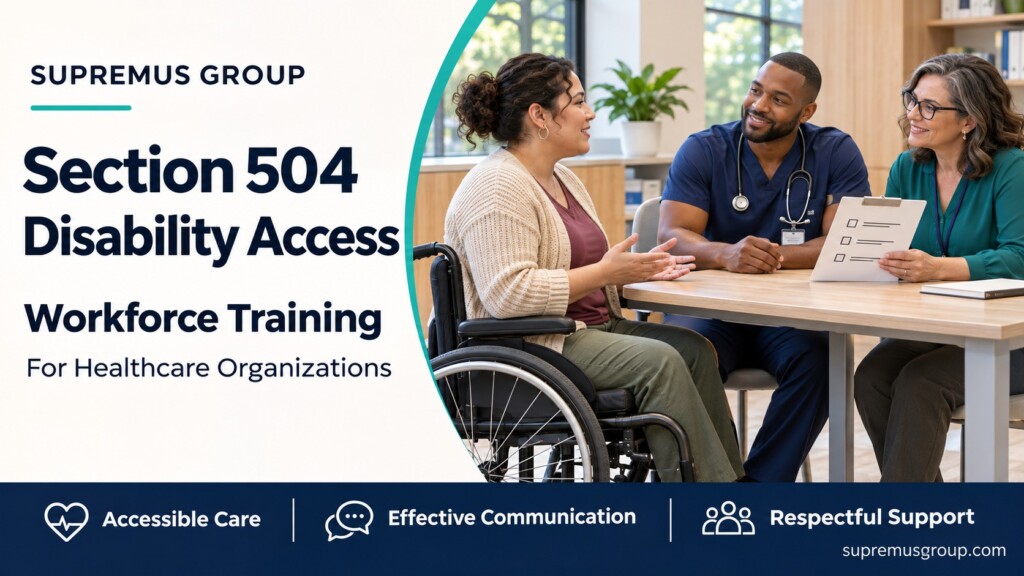
Supremus Group’s Section 504 Disability Access and Effective Communication for Healthcare Staff course prepares employees to recognize barriers, coordinate appropriate support, and document the next step. The training connects disability access principles with situations that clinical and administrative teams encounter at work.
The course focuses on healthcare programs and activities receiving federal financial assistance from the U.S. Department of Health and Human Services. Organizations can use the material alongside their own policies to strengthen staff understanding and support consistent responses to access needs.
Help Healthcare Leaders Set Clear Access Expectations
A written policy becomes useful when employees understand how to apply it. Staff need to know where to request assistance, how to recognize an ineffective arrangement, and when to involve another team.
This course helps healthcare leaders establish shared expectations around several practical questions:
- Who arranges communication support when the planned method does not work?
- How should staff respond when a routine procedure creates an access barrier?
- Which team coordinates accessible equipment and trained assistance?
- Where should ongoing access needs appear in the patient’s record?
- Who follows through when a request or complaint remains unresolved?
The examples encourage employees to act within their authority and make the next responsibility clear.
Top Workforce Priorities for Disability Access
Clear Responsibility for Patient Requests
An access request may begin with a scheduler, receptionist, nurse, or another employee. Staff should recognize the concern and know how to connect the patient with the appropriate support.
The course explains immediate responses, escalation, and the importance of identifying who will complete the next action.
Communication That Supports Participation
Patients need an opportunity to understand information, ask questions, and express decisions. Employees learn to consider the person’s communication preferences, the complexity of the discussion, and the setting.
The training also addresses situations where an interpreter or communication device is available but the exchange is still ineffective.
Equipment and Assistance That Are Ready for Use
An accessible examination depends on suitable space, working equipment, and appropriately trained staff. Learners review how to identify problems and coordinate assistance without reducing the quality of the examination.
The course includes planning around medical devices and awareness of access needs during facility emergencies.
Useful Information Between Departments
The next team needs clear information about what the patient requires and what has already been arranged. Learners review how to document access needs, protect privacy, and communicate remaining tasks through approved channels.
Which Teams Can Benefit?
Organizations can select participants according to their duties and the access concerns they are expected to recognize or resolve.
Relevant teams include:
- Patient access teams: Scheduling, reception, registration, and call center employees.
- Clinical and care coordination teams: Nurses, medical assistants, clinicians, discharge planners, and care coordinators.
- Patient support teams: Accessibility personnel, patient relations staff, and employees who arrange interpreter services.
- Operational support teams: Facilities, equipment, emergency preparedness, telehealth, and health record personnel.
- Healthcare leaders: Practice managers, department supervisors, compliance officers, and privacy staff.
The course provides a shared foundation while allowing employers to connect the material with each department’s responsibilities.
Expected Staff Learning Outcomes
After completing the course material, employees should be better prepared to:
- Recognize disability discrimination and barriers within ordinary healthcare procedures.
- Respond to requests based on individual needs rather than assumptions.
- Coordinate communication aids, qualified interpreters, and other appropriate support.
- Identify when an access arrangement needs reassessment.
- Respect patient choice and protect privacy when other people participate in care.
- Coordinate accessible examinations and trained assistance within their roles.
- Record useful access information and complete clear handoffs.
- Route complaints and unresolved concerns to the responsible person.
Eight Modules Across Four Training Areas
Disability Protections and Effective Communication
Modules 1 and 2 explain disability protections, reasonable changes to procedures, and effective communication.
Topics include mental health conditions, substance use treatment and recovery, qualified interpreters, video remote interpreting, and communication during consent and discharge.
Privacy coverage addresses approved interpreting services and HIPAA business associate requirements when an outside service acts in that role. Learners also consider the different responsibilities of workforce interpreters, companions, and patient-selected helpers.
Individual Communication and Participation Needs
Modules 3 and 4 address hearing, vision, cognitive, sensory, and speech access.
Employees explore accessible formats, communication devices, additional response time, and environmental adjustments. The material includes support for neurodivergent patients and ways to make transitions easier to understand.
The emphasis is on helping patients participate in their own care and communicate their choices.
Access Through Patient Services
Modules 5 and 6 cover scheduling, registration, telephone systems, digital forms, patient portals, telehealth, service animals, and patient companions.
Learners examine how routine procedures can prevent participation and when a request needs individual review. The course also explains how to clarify a support person’s role before sharing information or accepting decisions.
Equipment Readiness and Follow Through
Modules 7 and 8 address accessible examination equipment, coordination of trained assistance, medical devices during transfers, and emergency accessibility.
Employees then review access requests, objective documentation, electronic health record plans, complaint procedures, and escalation. A useful handoff identifies both the arrangements already in place and the person responsible for any remaining work.
Learning Structure and Practice Scenarios
The course contains:
- 98 slides organized into eight modules.
- Estimated learning time of 1 hour 27 minutes
- Certificate valid for: 2 Years
- Type of License: One user license cannot be transferred after login is assigned.
- Eight fictional healthcare scenarios with answer explanations.
- Visual explanations of communication, access, privacy, and coordination.
- Module reviews that connect the material with everyday responsibilities.
- A format designed for individual learning at each employee’s own pace.
Learners consider how to respond when interpreting fails during a consent discussion, an accessible examination table is unavailable, or a manager proposes charging a patient for required communication support after a complaint.
These situations help employees think through the immediate response, the appropriate contact, and the information another team will need.
Connecting the Training With Your Organization’s Procedures
Healthcare leaders can reinforce the course by giving employees clear local information.
Confirm the Responsible Contacts
Identify the people who handle interpreter requests, accessibility concerns, privacy questions, equipment failures, and urgent clinical escalation.
Explain Where Access Plans Belong
Show staff the approved location for ongoing access information in the electronic health record. Explain how authorized employees use that information during scheduling, care, and handoffs.
Clarify Decision Authority
Help employees understand which arrangements they can make and which requests require review by a supervisor, clinical lead, accessibility contact, or compliance team.
Review Recurring Barriers
Ask departments to identify an access problem they encounter regularly. Assign responsibility for follow-up and check whether the response addresses the patient’s needs.
These are suggested employer activities that connect the training with existing workplace procedures.
Healthcare Training Experience Since 2006
Supremus Group has served more than 3,000 companies since 2006. Its broader offerings include HIPAA training, compliance templates, and related services for healthcare organizations and business associates.
This experience provides context for Supremus Group’s approach to workforce education. The Section 504 course focuses on helping staff recognize access needs, understand their responsibilities, and coordinate an appropriate response.
Healthcare leaders can use the course as part of their staff education plans while reinforcing the procedures and resources available within their own organizations.
Frequently Asked Questions
Discuss Section 504 Training for Your Workforce
Prepare your employees to recognize disability access concerns and coordinate the right next step.
Contact Supremus Group to discuss Section 504 Disability Access and Effective Communication for Healthcare Staff and how the course fits your organization’s education plans.
Email: bob@supremusgroup.com
Phone: (515) 865-4591.
USER RATING:
Section 504 Disability Access and Effective Communication for Healthcare Staff is rated 4.9 out of 5 by 864.