
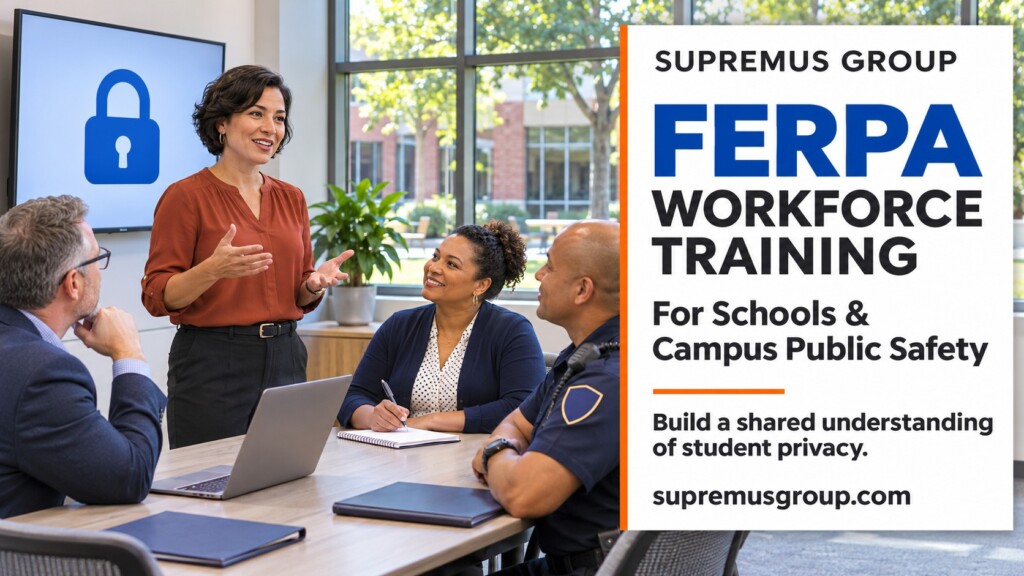
 School safety involves people with different duties. An officer may need information to respond to a threat, a records custodian may need to review a request, and a school administrator may need to coordinate the response. Clear responsibilities help these teams work together while respecting student privacy.
Supremus Group’s FERPA for School Resource Officers and Campus Public Safety Professionals course gives organizations a structured way to introduce the Family Educational Rights and Privacy Act (FERPA) to personnel working in school safety roles. It connects student record protections with investigations, emergency response, technology use, and cooperation between departments.
Make responsible information sharing a leadership priority. Prepare your staff to identify the rules that apply, use the correct review process, and explain the basis for their actions.
Help Every Team Leader Set Clear Expectations
A shared training foundation gives supervisors and staff a common language for discussing student information. The course encourages teams to look closely at the record, the person requesting it, and the task being performed.
Organizations can use the lessons to support:
- Clearer responsibilities: Help personnel recognize the limits of their role and locate the person authorized to decide.
- More focused requests: Encourage staff to explain what information they need and why.
- Consistent coordination: Connect public safety duties with the school’s records, privacy, and incident response processes.
- Trust in daily practice: Reinforce careful handling of information entrusted to the school.
The course supports staff education as part of the institution’s broader privacy and safety program.
Select Participants by Their Responsibilities
School and Campus Safety Personnel
School resource officers, district police, campus police, security personnel, and public safety supervisors are the primary audience. The lessons address the student information they may encounter while protecting people and supporting school operations.
Education and Privacy Personnel
Administrators, records custodians, privacy staff, and school safety coordinators can use the course to understand the requests officers bring to them. A shared review of the examples can help clarify where one person’s responsibilities end and another person’s review begins.
Personnel Working Across Organizations
Outside officers assigned to schools and members of threat assessment teams may also benefit. Their duties can involve both school functions and agency responsibilities, making purpose limits and later sharing especially relevant.
Training Scope and Learning Materials
- Eight modules covering federal FERPA principles and their use in school safety work.
- 110 slides that include the modules, course orientation, and reference material.
- 12 fictional cases with decision pauses and guided debriefs.
- Three worked examples addressing a focused request, an emergency disclosure record, and a digital evidence transfer.
- Estimated learning time of 1 hour 6 minutes.
- Visual learning aids that compare records, show decision steps, and summarize each module.
The course prepares learners for a separate assessment. Organizations should also plan time for local procedures and questions that depend on their jurisdiction or assigned duties.
Learning Goals for Your Workforce
The training helps personnel develop the ability to:
- Identify the record holder and the status of the specific information being requested.
- Recognize parent and eligible student rights when handling access or correction requests.
- Evaluate whether consent or an applicable exception supports a proposed exchange.
- Understand how school official duties differ from other law enforcement responsibilities.
- Coordinate urgent disclosures with the appropriate decision maker and recipients.
- Recognize when health, counseling, disability, or other sensitive information needs added review.
- Handle recordings, messaging, and automated output through approved processes.
- Document relevant decisions and preserve evidence within assigned responsibilities.
- Find the local guidance needed to resolve a question or report a concern.
Course Curriculum
Module 1: Establishing the Student Privacy Framework
Introduce the records and institutions covered by FERPA and the rights that belong to parents or eligible students. Examine how information can identify a student, even without a name. The module also addresses requests to inspect or amend records and the treatment of firsthand observations.
Module 2: Managing School and Law Enforcement Record Boundaries
Follow information as it moves between a law enforcement unit and other school offices. Review the conditions for qualifying unit records and the treatment of school copies, disciplinary files, and video. Lessons separate the duty to preserve material from the authority to disclose it.
Module 3: Defining Access and Disclosure Responsibilities
Examine written consent and the exceptions relevant to school safety duties. Topics include school official status, legitimate educational interests, outside agency agreements, directory information, legal process, and juvenile justice requests. Teams learn to check the conditions and limits attached to each proposed use.
Module 4: Coordinating Threat Reviews and Emergency Sharing
Study how information can support threat assessment work and what changes when an actual health or safety emergency arises. The module addresses the basis for the decision, the people who need information, and required records. It also considers preparation exercises and restrictions on later disclosure.
Module 5: Handling Student Health and Support Information
Review school health records, counseling files, treatment records, and disability support information. Learn how the holder and use of a record affect FERPA and HIPAA analysis. Examples address urgent care coordination, sensitive substance use treatment information, and requests that arise after the emergency.
Module 6: Directing External Requests and Campus Communications
Explore the different considerations behind parent communications, safety alerts, disciplinary disclosures, and public inquiries. Other topics include missing students, information sent to another school, and coordination with Title IX personnel. Learners examine the review needed before information leaves its original context.
Module 7: Supervising Technology Use and Incident Coordination
Address approved communication systems, outside services, and AI tools used with student information. The module covers accuracy checks, privacy concerns, cybersecurity escalation, and cooperation with IT security. It also examines digital evidence documentation, complaint procedures, and the FERPA enforcement framework.
Module 8: Connecting Federal Lessons With Local Operations
Use a final incident to work through several records and requests from different people. Apply the source, purpose, authority, scope, and safeguards checks to each exchange. Identify the approved contacts, forms, technology rules, and local requirements that personnel need for their own workplace.
Practice Cooperation Across Departments
The fictional cases help learners discuss the responsibilities of different participants in the same event. Each case provides time to choose a response before explaining the relevant rule and its limits.
Course situations include:
- Video held by two offices: Campus police and a conduct office need to understand how the purpose and handling of their copies affect review.
- An urgent student support request: Safety personnel and school staff consider which information is needed during a crisis.
- A medical response followed by an investigation: Responders examine why a care handoff and a later request for hospital records require separate analysis.
- An incident with several interested parties: A parent, detective, reporter, and clinician seek information held by different organizations.
The worked examples add practical detail about writing a request, documenting an emergency disclosure, and recording an evidence handoff. These exercises can support discussions between officers, supervisors, and the school staff responsible for records.
Put the Training Into Your Organization’s Procedures
Identify the People Who Need the Course
Start with job duties. Include personnel who request, receive, approve, or safeguard student information during school safety work. Consider the supervisors and partner staff who need to understand those interactions.
Connect the Lessons With Approved Local Guidance
Have the responsible school or agency officials identify the current records process, emergency decision makers, backup contacts, and approved systems. Review the local rules for recordings, public requests, sensitive records, and incident reporting.
Review Decisions Together
Use fictional situations to discuss who should act, what information is needed, and which reviewer should resolve an open question. A shared discussion can reveal different assumptions before they affect a real incident.
Keep Instructions Available
Maintain approved contacts, forms, and procedures where staff can find them. Assign responsibility for keeping this guidance current when systems, duties, or requirements change.
An Established Provider of Privacy Training
Supremus Group LLC began in 2006 and provides privacy training, HIPAA compliance resources, and consulting services. The company reports more than 3,000 clients across its wider business.
The FERPA course adds focused instruction for education and public safety settings. Organizations can pair the course’s visual explanations and applied cases with approved local guidance to help staff use the lessons in their daily work.
Questions From School and Agency Leaders
Related Training and Organizational Support
HIPAA Training for Law Enforcement and Public Safety
For personnel who also request or receive health information, explore training on healthcare disclosures and information handling issues relevant to public safety duties.
View Law Enforcement and Public Safety HIPAA Training
Cybersecurity Awareness Training
Support broader workforce awareness of phishing, suspicious activity, information protection, and reporting responsibilities.
Explore Cybersecurity Awareness Training
HIPAA Compliance Services
Organizations with applicable healthcare responsibilities can also explore Supremus Group’s HIPAA consulting services, including privacy and security policies, risk analysis, and compliance reviews.
Make Student Privacy a Top Priority Across Your Organization
Give your personnel a stronger foundation for cooperation when school safety and student information meet. Supremus Group can discuss FERPA training options for your district, college, university, or public safety agency.
When contacting us, include your organization type, the roles of the intended learners, and the approximate number of participants. Our team can provide current pricing and enrollment information.
Email: bob@supremusgroup.com
Phone: (515) 865-4591.
USER RATING:
FERPA Workforce Training for Schools and Campus Public Safety is rated 4.9 out of 5 by 91 users.